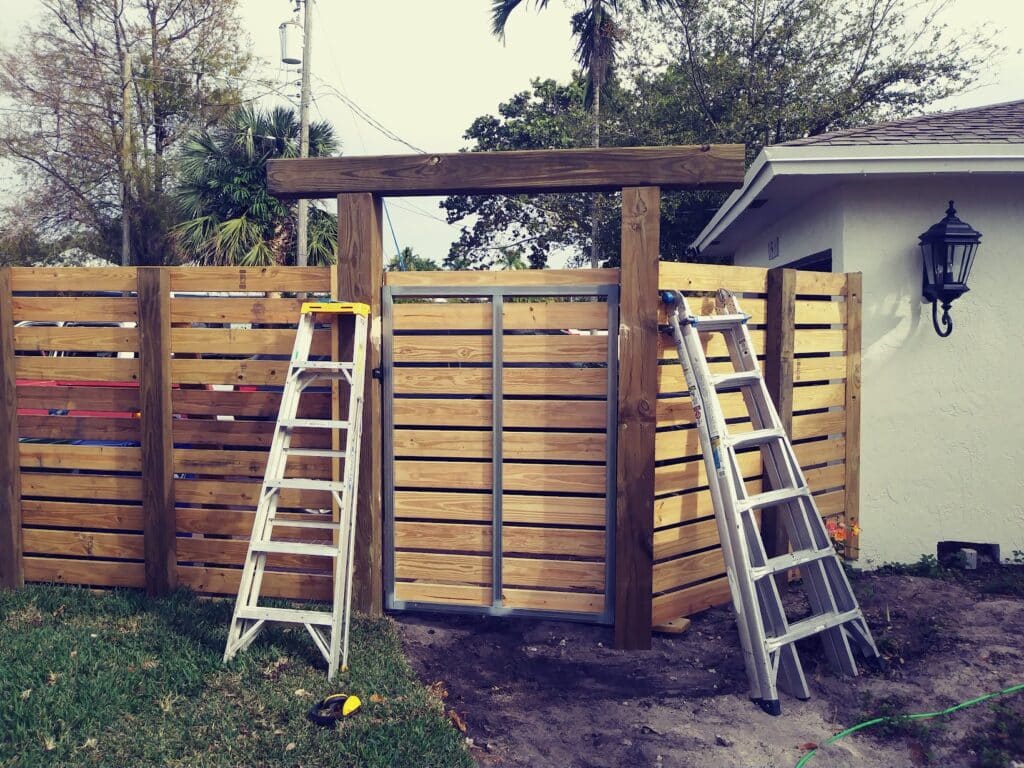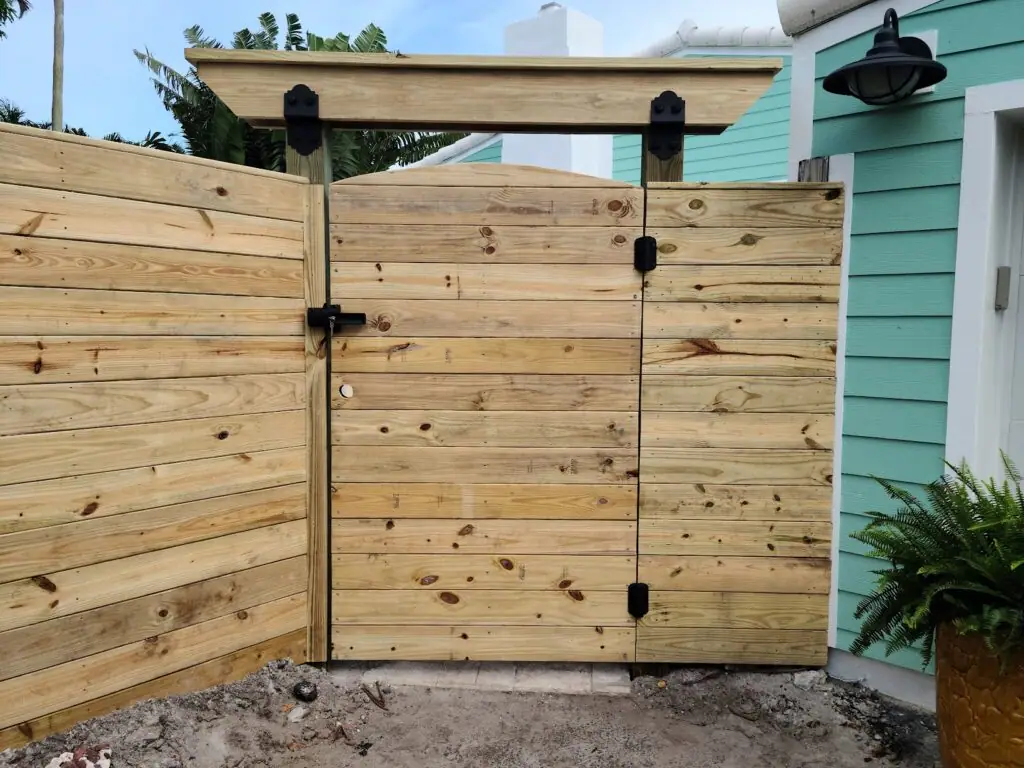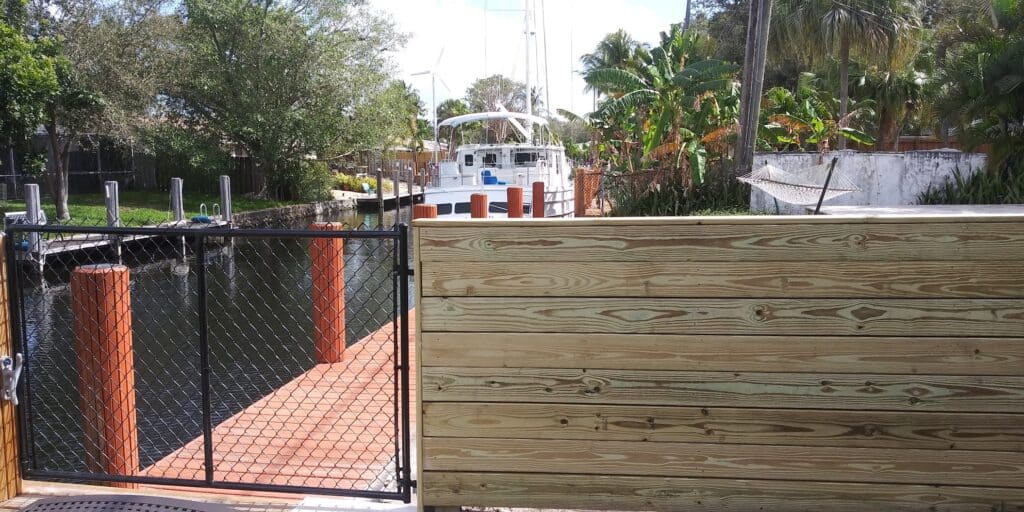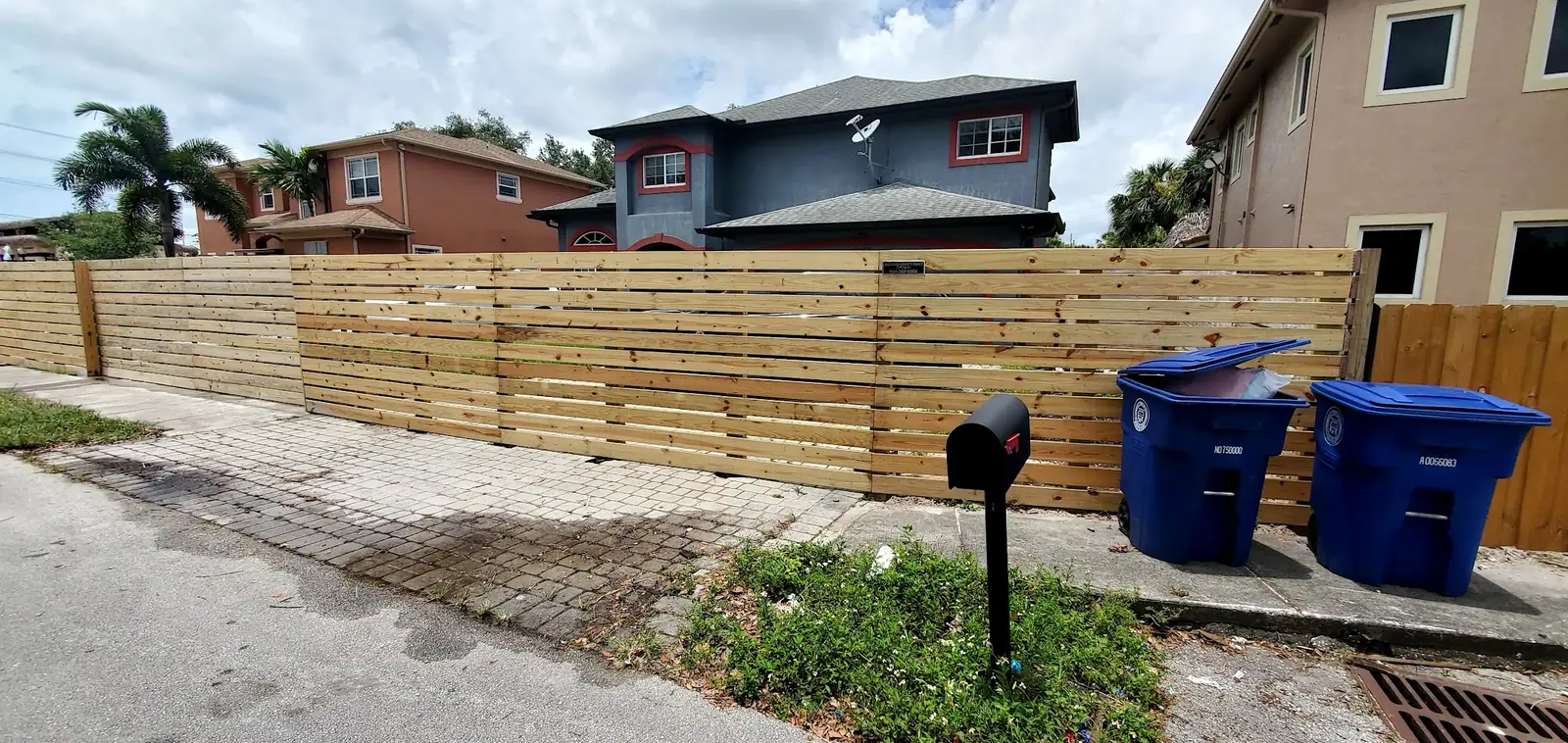
The Link Store carries everything you need to build and finish a wood fence across Fort Lauderdale, Broward County, and the wider South Florida tri-county area — the hardware, fasteners, post-setting concrete, stains and sealants, tools, and wood-steel-frame composite gates that hold up in our humidity, salt air, hurricane wind loads, and intense UV. For the cedar, redwood, or pressure-treated boards and posts themselves, we’ll point you to a trusted local lumber supplier. Walk-ins are welcome, contractor pricing applies to everyone, and there are no minimum orders whether you’re patching one back-yard run or staging a full subdivision.
What we stock for wood-fence projects
We stock the hardware, finishing, structure, and gates that go around the lumber — bring your measurements and we’ll help you spec quantities the first time, and point you to a lumber yard for the boards and posts.
Post caps and finials
Caps protect the end-grain of every post — that’s where rot starts. We carry:
- Galvanized and powder-coated metal caps
- Solar caps with low-glare LEDs for driveway and gate posts
- Decorative finials, ball tops, and ornamental copper caps
Fence rails
Top, middle, and bottom rails in metal and composite — the rot-proof structural option behind a wood-clad face, and far more durable than timber rails in our climate.
Hardware
The fence is only as strong as what holds it together. Stocked by the box:
- Galvanized nails and screws — the standard for inland projects
- Stainless-steel screws — what we recommend within a couple of miles of the coast
- Hinges, latches, drop-rods, and gate stops
- Brackets, fence ties, post anchors, and spike anchors
Wood-steel-frame gates
Composite gates built on a welded steel frame with a wood-look infill — the stocked gate option for wood-fence runs, far more stable in our humidity than an all-timber gate, with the full hardware set: heavy-duty hinges, latches, drop-rods, and self-closing options.
Stains and sealants
Florida sun and rain will gray and split untreated wood faster than most homeowners expect. We carry:
- Wood stains in clear and tinted finishes
- Clear sealants for natural-look protection
- UV-resistant sealants — the ones that actually matter down here
- Waterproofing for splash zones, pool decks, and ground-contact applications
Tools
Manual post-hole diggers and two-person augers, post drivers, levels, drills, circular saws, framing nailers, and the safety gear you should already be wearing.
Site essentials
Concrete mix for setting posts, gravel for drainage at the base of the post hole, weed barrier for under decorative gravel runs, and wood preservatives for cut ends and field treatments.
Choosing the right wood for South Florida
What works in Atlanta or Charlotte does not necessarily work in Broward. Pick wood and hardware that match the conditions on your specific lot.
Humidity and rot resistance
Year-round humidity, summer rain, and the occasional standing-water flood event will rot untreated lumber faster than most homeowners expect. Western red cedar and redwood have natural oils and tannins that resist rot and insects without chemical treatment, which is why they’re the most popular choice for visible fence faces. For posts and any board in higher-moisture spots, properly pressure-treated southern yellow pine is more cost-effective and fights back against decay — make sure the treatment rating is appropriate to the application (above-ground vs ground-contact).
Hurricane wind loads
South Florida fences need to survive sustained winds and gusting through storm season. Two practical levers: post size and post depth. 4×4 posts are the workhorse for standard 4- to 6-foot residential fences; step up to 6×6 for taller fences, gate posts, or exposed runs with no wind break upwind. Set every post in concrete to a depth that gets you below the topsoil and into something that bites. Local code in some Broward and Palm Beach municipalities is more demanding than others — start with our complete guide to fence permits in Broward County for the specifics that apply to your address.
Salt air corrosion
If your project is east of US-1, or anywhere within a couple of miles of the coast — Hollywood, Hallandale Beach, Pompano Beach, Deerfield Beach, the barrier islands — galvanized hardware will rust through faster than you’d like. Stainless-steel fasteners and hinges cost more up front but outlast the wood they’re holding together. Inland projects are usually fine on hot-dipped galvanized.
UV exposure
Florida sun is hard on every exterior finish. Plan on sealing or staining a wood fence the first season and re-coating every year or two on the sun-exposed side. UV-resistant sealants make a meaningful difference — bare cedar will silver fast without protection, and pressure-treated pine will check and split if it goes too long unsealed.
Permits and Florida fence rules — what Broward County wants
Most fence installs in Broward, Palm Beach, and Miami-Dade need a permit, and the rules vary by city — height limits, setback distances, corner-lot visibility triangles, and HOA overlays on top of the county code. Don’t skip this step; the consequences of an unpermitted fence range from fines to having to tear it out. Start with the relevant guide:
Common questions about wood fence supplies
What’s the best wood for fences in South Florida?
For most yards, the choice is between Western red cedar, redwood, and pressure-treated southern yellow pine. Cedar gives you rot resistance, insect resistance, and a clean look without chemical treatment — the right pick for fence faces you’ll actually see. Redwood is the premium option where appearance matters most. Pressure-treated pine costs less and lasts well underground or under stain, which is why it’s the most common post material. The right answer is usually a mix: cedar or redwood for visible pickets, pressure-treated pine for posts and ground-contact framing.
How deep should wood fence posts be in Florida?
The standard rule of thumb is one-third of the total post length in the ground, set in concrete — so a 6-foot fence with an 8-foot post needs roughly a 2-foot bury, plus a few inches of gravel at the base of the hole for drainage. South Florida sand and a high water table mean you have to commit to that depth; under-buried posts walk in storms. For sizing context on the fence itself, see our guide on the 5-foot vs 6-foot fence question.
Do I need a permit for a wood fence in Broward County?
In almost all cases, yes — and the same is true across Palm Beach and Miami-Dade. Each city has its own height limits, corner-lot rules, and HOA overlays on top of the county code. Our complete guide to fence permits in Broward County walks through what you need before breaking ground.
How long does a wood fence last in South Florida?
It depends on three things: the wood species, the quality of the install (post depth, drainage, hardware), and how diligently you re-seal. A pressure-treated pine fence on properly set posts with regular sealing will outlast a fancy cedar fence on shallow posts with no maintenance, every time. Stainless-steel hardware near the coast also matters more than most people think. Build it right, seal it on schedule, and you’ll get years of useful life — neglect any of those and you’ll be replacing pickets sooner than you’d like.
Do you sell to homeowners, or just contractors?
Both. There’s no minimum order, no membership card, and no “trade only” gate. Contractor pricing applies to everyone, whether you’re picking up a single box of fasteners for a weekend repair or staging materials for a new-build subdivision.
Do you offer delivery in Broward County?
Call us at (954) 306-6968 with your project address and material list and we’ll talk through delivery options for your job.
What’s the difference between pressure-treated pine and cedar for fencing?
Cost versus longevity versus look. Pressure-treated southern yellow pine is the budget-friendly choice — it costs less per linear foot and, when treated for ground contact, lasts a long time underground or under stain. Cedar is more expensive but earns its keep with natural rot and insect resistance, a tighter grain, and a finish that takes stain or oil beautifully. Many South Florida builds use both: pressure-treated pine for posts and back framing, cedar for the visible pickets.
Should I get a 5-foot or 6-foot wood fence?
Six-foot is the default for back-yard privacy in most Broward and Palm Beach municipalities. Five-foot is more common in front-yard runs and corner lots where setback or sight-line rules apply. The right answer depends on your goal (privacy, pets, pool code) and what your city allows. We’ve written it up in detail in our guide to choosing between a 5- and 6-foot fence.
Why builders and homeowners across South Florida choose The Link Store
- Hardware, fasteners, finishes, and composite gates selected for South Florida conditions — humidity, salt, hurricane wind loads, and UV all factored into what we put on the racks
- Open to homeowners and contractors — no minimum orders, contractor pricing for everyone
- Knowledgeable staff who’ll help you spec the right materials and quantities the first time
- Conveniently located in Oakland Park, serving the tri-county area from a real working yard
★★★★★
“The Link Store has been my go-to place for wood fence supplies in Fort Lauderdale. Their selection is top notch, and the quality of their materials is amazing. The staff are incredibly helpful and knowledgeable, making the entire process really easy. My new fence looks fantastic and is built to last. I highly recommend them to anyone in Broward County!”
Where we deliver and supply — Broward County and beyond
We supply wood fencing materials to projects across South Florida from our Oakland Park location. Pickup is welcome any time we’re open; ask about delivery for your specific address.
- Broward County
- Fort Lauderdale, Hollywood, Pembroke Pines, Miramar, Coral Springs, Pompano Beach, Plantation, Davie, Sunrise, Weston, Deerfield Beach, Coconut Creek, Tamarac, Margate, Lauderhill, Oakland Park, Parkland, Cooper City
- South Palm Beach County
- Boca Raton, Delray Beach, Boynton Beach
- North Miami-Dade County
- Aventura, Miami Gardens, North Miami Beach
If your project is outside these areas but still in South Florida, give us a call — we may still be able to help.
Other supply categories
If you’re scoping a job that mixes materials, we supply the other major fence systems too:
Visit The Link Store or get a quote
Stop by the yard in Oakland Park to see materials in person, or call ahead with your measurements and we’ll have your order ready when you arrive. Quotes by phone are welcome — bring or send a photo of the run if you have one.
The Link Store 5059 NE 13th Ave, Oakland Park, FL 33334 (954) 306-6968 Mon–Fri 7:30 AM – 4:00 PM • Sat 7:30 AM – 12:00 PM • Closed Sunday